
Project overview
For this UX writing case study, I redesigned the welcome screens for a relationship wellness app. The platform’s core offering is a hybrid model of professional therapy and self-guided exercises designed to help couples build healthier habits between sessions. My scope for this project was to introduce users to the app’s features and value proposition during the initial onboarding flow.
Goals
The primary objective was to transform the welcome flow into a high-value introduction that drives immediate engagement. I focused on three strategic pillars:
Minimizing cognitive load: I audited the flow for terminology inconsistencies to ensure a seamless transition from sign-in to the first user action.
Benefit-driven messaging: I shifted the focus from what the features are to why they matter, using copy that highlights the tangible value for the couple’s relationship.
Empathetic voice & tone: I refined the brand voice to feel like an encouraging, personal guide — moving away from generic or high-pressure language to foster a sense of psychological safety.
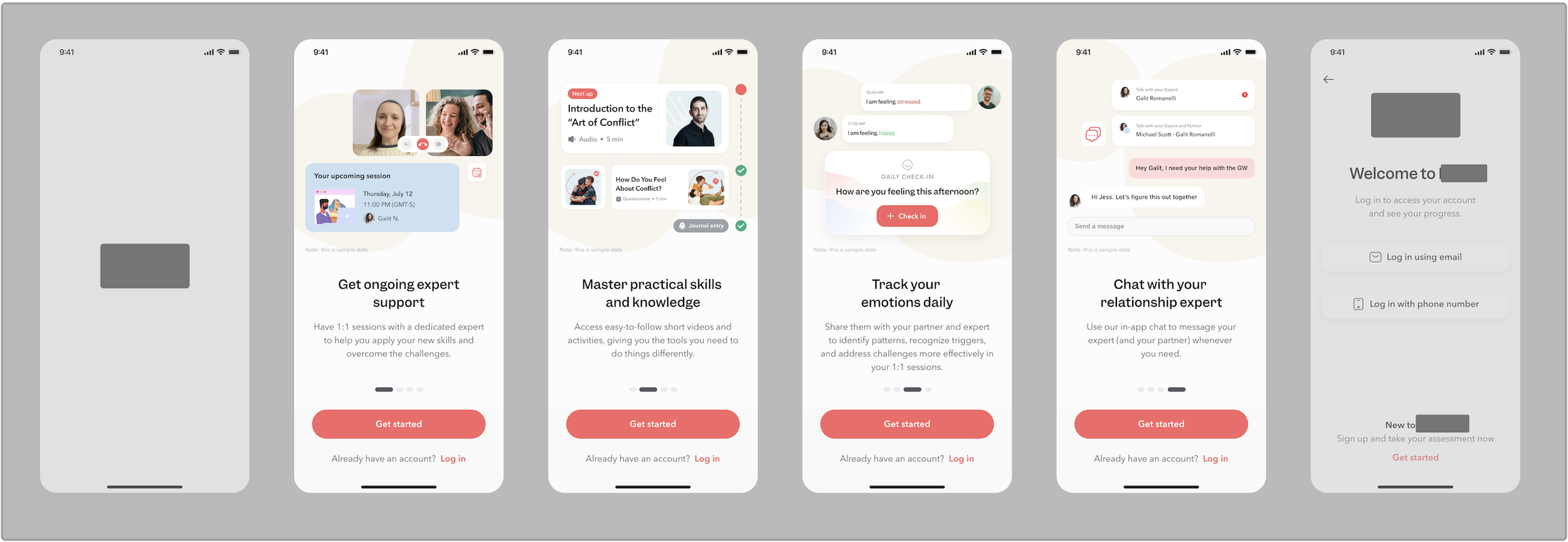
Relationship App: Old UX copy
My process
Market & comparative research: To define a resonant brand voice, I analyzed existing relationship wellness touchpoints and performed a comparative audit of Headspace. I specifically studied how Headspace handles high-stakes, emotional user entries to inform a tone that feels both calm and supportive.
Content audit & logic review: I evaluated the original screens for clinical language, high cognitive load, and confusing CTAs. I also reviewed the screen logic to ensure the narrative flow felt intuitive rather than fragmented.
Tone & style framework: Based on my research, I developed a brief keyword list and tone guidelines. My North Star was to balance clinical credibility with emotional accessibility, ensuring the copy never felt pressuring or generic.
Information hierarchy: I prioritized a "Header-First" strategy. Given the sensitive nature of the user's journey, I designed the headers to convey the core value independently, using subheaders only for secondary context or supportive detail.
Iteration & drafting: To explore a wide range of directions, I used AI prompting to generate and refine multiple header/subheader variations. This allowed me to quickly test different emotional angles before finalizing the UX copy.
Challenge
The primary hurdle was to introduce a multi-faceted wellness platform that combines live therapy with self-guided digital tools without overwhelming users at a high-stress entry point. The original experience relied on feature-heavy language that could feel judgmental and confusing, while failing to be sufficiently benefit-driven. My challenge was to reframe these technical touchpoints into a cohesive narrative that felt both emotionally safe and immediately valuable. This ensured users felt empowered to take their first step toward relationship wellness without the weight of confusing or high-pressure language.
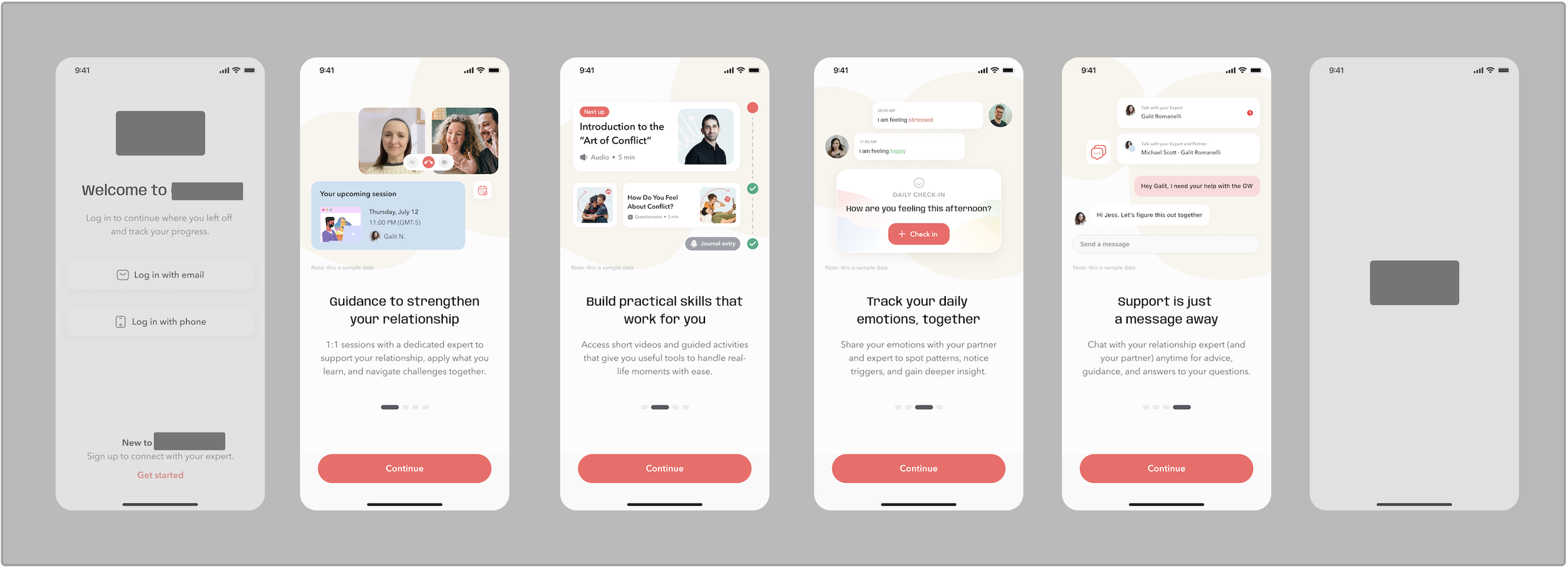
Relationship App: New UX copy
Results
While this was a spec project without live user data, the rewritten onboarding flow delivers immediate strategic value by addressing the user’s emotional state at the point of entry.
Improved user confidence: By shifting from feature-heavy language to benefit-driven copy, the flow now empowers users to engage with the features rather than feeling unsure about the app’s value.
Reduced cognitive load: The "Header-First" strategy ensures that, even if a user scans the screen, they immediately understand the step's value proposition.
Strengthened emotional resonance: The new tone of voice fosters psychological safety, making the app feel like a supportive partner rather than a high-commitment tool, which is crucial for high-stakes wellness apps.
Next steps
A/B testing: Launching a controlled test comparing the original high-commitment copy against the new supportive copy to measure impact on conversion metrics, specifically looking for a decrease in drop-off rates on the first screen.
Usability testing: Conducting qualitative interviews with couples to test the new copy in context. This would determine if the revised tone actually reduces anxiety and makes them feel more supported compared to the original version.
Accessibility audit: Ensuring the revised copy meets WCAG 2.1 guidelines, specifically for users with cognitive disabilities who may find high-stress situations particularly overwhelming.
Comprehensive tone guidelines: Expanding the brief keyword list into a full brand voice guide for the product team. This would ensure that the supportive, low-pressure tone is applied consistently to push notifications, emails, and therapist messaging.